Why Blindly Following Day Trading Alerts Is a Losing Game (And How to Fix It)
Let’s have a brutally honest conversation about day trading for a second. Have you ever joined a flashy Discord group, waited eagerly for the "guru" to call out a play, blindly smashed the buy button the second the notification popped up, and instantly found yourself down 10%?
You aren't alone. It is incredibly frustrating, and it’s a trap that almost every new trader falls into. The market moves lightning fast, and keeping up can feel impossible. Naturally, people turn to trading alerts from outside services to make the process easier.
But here is the hard truth: using other people's trading alerts as a copy-paste strategy for making money is incredibly risky, stressful, and rarely leads to long-term, consistent profitability.
If you truly want to survive and thrive in the stock market, you have to take the training wheels off. Today, we are going to break down why copying trades is a losing game, how you should actually be using outside services, and most importantly, how to set your own trading alerts like a seasoned professional. Grab a coffee, pull up a chair, and let’s dive into building your personal edge. 📈
The Brutal Truth About Blindly Following Trading Signals
Let’s talk about why copying someone else’s alerts is so dangerous. On paper, it sounds like a dream: someone else does the hard work, you click a button, and you both get paid. In reality, the mechanics of the stock market make this nearly impossible to execute consistently.
1. The Slippage and Latency Trap By the time a trader enters a position, types out the alert, sends it to the chat, and you receive it on your phone, valuable seconds—sometimes minutes—have passed. In the world of day trading, seconds matter. By the time you hit "buy," the price has already surged. You end up buying at the top (often providing exit liquidity for the person who called the trade), and the moment the stock pulls back, you are immediately in the red.
2. The Psychology Mismatch Trading is deeply personal. Your risk tolerance, account size, and emotional control are completely different from the person issuing the alert. If a pro trader sends an alert, they might have a $100,000 account and can easily stomach a $500 drawdown. If you are trading with a $2,000 account and trying to mimic their play, that same drawdown will trigger pure panic. If you struggle with this, take a detour and read our guide on mastering trading psychology and avoiding FOMO
3. You Aren't Learning the "Why" When you blindly follow, you are outsourcing your brain. You don't know why the trade was taken, what the macro environment is doing, or where the actual support levels are. If the alert service disappears tomorrow, you are left with no skills and no way to generate income.

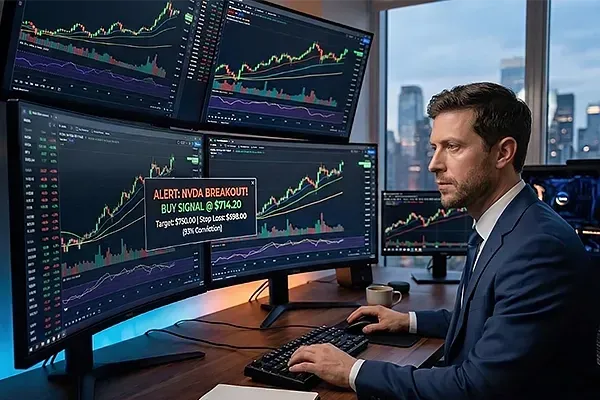
A frustrated trader realizing the dangers of blindly following other people's trading alerts instead of doing their own technical analysis.
How to Use Outside Trading Alerts the Right Way (For Learning)
Does this mean you should completely ignore alert services, communities, or chat rooms? Not at all! Being part of a community is essential. The secret is shifting your perspective.
Trading alerts from outside services are best used for guidance, studying, and reverse-engineering—not for blindly clicking "buy."
When you receive an alert from a trusted service, treat it as a live case study. Don't rush to enter the trade. Instead, pull up your own charting software and ask yourself these questions:
Why did they choose this specific price point for an entry?
Where is the nearest structural support or resistance level?
What was the volume looking like right before the alert was triggered?
Where did they place their stop-loss, and does that align with standard technical analysis?
By studying where professional traders set their alerts, you learn to identify high-probability setups. You start to see the matrix. Over time, you’ll notice that you are spotting the setups before the alert even hits your phone. That is when you know you are actually leveling up.
If you want to understand more about the underlying market mechanics that professional traders look at, the SEC's educational research on market structure is a fantastic, completely free place to build your foundational knowledge.
Why Setting Your Own Trading Alerts is the Ultimate Cheat Code
Once you graduate from studying others and start relying on your own analysis, everything changes. Setting your own alerts is how you take back your time and your sanity.
1. It Cures "Screen Fatigue" You shouldn't have to be glued to your monitors from the opening bell to the close. Staring at charts all day leads to burnout, and burnout leads to impulsive, bored trades. Setting your own alerts allows you to walk away, live your life, and only return to the screens when the price reaches a zone you specifically chose.
2. It Forces Discipline and Pre-Planning When you set an alert, you are making a logical decision before the emotional heat of the moment. You are saying, "I will only be interested in this stock if it proves itself by crossing this exact line." This eliminates the urge to chase green candles in the middle of nowhere.
3. Ultimate Autonomy When you rely on your own alerts, you become self-sufficient. You trust your own thesis, you manage your own risk, and when you secure a win, you know it was 100% because of your own skill.
How to Set Your Own Trading Alerts Like a Pro: Step-by-Step 🛠️
Alright, let’s get tactical. How do you actually set these up so they are useful and not just annoying notifications buzzing in your pocket all day?
Step 1: Identify the Macro Trend Before setting a single alert, look at the broader market. Are the SPY and QQQ trending up, down, or chopping sideways? If the market is bleeding, you probably shouldn't be setting aggressive breakout alerts on small-cap stocks. Align your alerts with the broader market momentum.
Step 2: Map Out Key Levels (Support and Resistance) Open up your daily and hourly charts. Find the obvious zones where buyers have historically stepped in (support) and where sellers have historically taken control (resistance).
Your goal is not to trade in the middle of the "chop." Your goal is to trade at the extremes. For a deep dive into identifying these zones, check out our article on How to profit using Support And resistance.
Step 3: Define Your Trigger Don't just set an alert right at the exact entry price. Set it slightly before your entry zone. For example, if you want to buy a stock breaking out over $100, set your alert for $99.80. This gives you time to sit down at your desk, check the volume, assess the momentum, and physically prepare to execute the trade.
Step 4: Use Specific Notes Most platforms (like Tc2000 or Thinkorswim) allow you to add custom text to your alerts. Use this! Don't just let the alert say "AAPL crossed $150." Write a note to your future self: "AAPL approaching key $150 breakout. Check for high relative volume before entry. Stop loss goes under $148." This brings you back into the logical mindset you had when you originally mapped out the trade.
To make sure your technical foundation is rock solid when drawing these lines, reputable educational books like Technical Analysis of Stock Trends are always worth a read.
Common Pitfalls When Setting Your Own Alerts
Even when doing it yourself, there are a few rookie mistakes you need to actively avoid to protect your capital:
Alert Fatigue: Do not set 50 alerts across 50 different tickers. If your phone is vibrating every two minutes, you will start ignoring them, completely defeating the purpose. Stick to your top 3 to 5 highest-conviction setups for the day.
Placing Alerts Too Tight: If a stock is currently trading at $50.00, setting an alert for $50.05 is useless. Give the stock room to breathe and only set alerts for meaningful structural breaks.
Forgetting Position Sizing: An alert firing off is an invitation to review a trade, not a guarantee it will work. Always calculate your risk before entering. We highly recommend reviewing our article on Position Sizing and Using a Share Size Calculator so you never risk more than you can afford to lose on a single play.
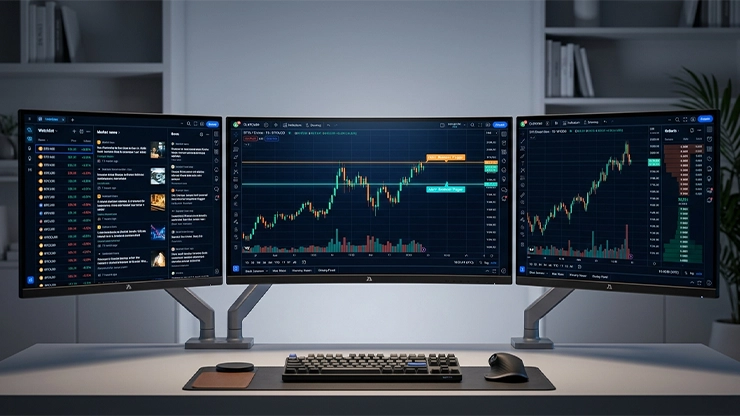
A professional trader's desk showing how to properly set trading alerts for optimal entry and exit points on a stock chart. 🖥️📊
Summary: Tying It All Together
Let's quickly recap the blueprint for mastering alerts:
Blindly following other people's trading alerts is a high-risk gamble due to latency, slippage, and conflicting risk tolerances.
If you use outside alert services, use them as an educational tool to reverse-engineer professional trades and learn where to spot high-probability setups.
Setting your own alerts is the key to curing screen fatigue, removing emotions, and trading with discipline.
Always set your alerts slightly ahead of your target entry price to give yourself time to react, and never enter a trade without a clearly defined stop-loss.
Trading is a marathon, not a sprint. Relying on someone else to feed you trades will only keep you dependent. Learning how to chart, plan, and set your own triggers is the exact moment you transition from a gambler into a true market operator.
Ready to Stop Guessing and Start Learning?
If you are tired of the stressful cycle of chasing other people's trades and want to finally learn how to fish for yourself, you are in the right place.
At Wall Street Sicarios, we don't just hand out blind signals. We teach you the mechanics behind the trades. We show you exactly where we are looking, why we are looking there, and how to spot these setups on your own. Our community is built on education, transparency, and helping you build your personal edge in the market.
Stop following the herd. It’s time to become the hunter.
📞 Contact us today at: [832-429-5282]
💻 Visit us and join the community at: [www.wallstreetsicarios.com]
✉️ Have questions about our mentorship? Shoot us an email at: [[email protected]]
Keep your risks tight, trust your own analysis, and we'll see you in the green! 💸


